Wednesday, September 22, 2010
Uncle Tony’s last dance in the Mariaba Band
Anthony Torres, popularly known as ‘Uncle Tony’ was buried at his beloved Santa Rosa on September 10. He was 77.What a fitting finale to a remarkable musician and dancer of our Banchikili and Horopo heritage!It was to save the Amerindian Horopo tunes from going extinct that the Mariaba String Band was formed. The famous Aloysius La Rose aka “Uncle Bill’ could not play his violin any longer and no replacement was around during the early 1990’s.I approached Uncle Tony who recommended some men and in November 1993 the band was formed with Basil Rodrigues leader, guitarist, singer; Tony Torres guitar, banjo dancer, Frank Hernandez horopo violin man; Pedro Francis shack shack specialist; Mannie Cornelius banjo and guitar player. In later years Vincent Sukan, Basil Fernandez, Nash Francis and Aloysius Torres joined the band. Frank Hernandez could play fluently thirty two of the Banchikili tunes handed down from yesteryear by our Spanish Warrau and Arawak forefathers.Uncle Tony was adept at the Snake Dance which he and his wife Shefa, performed with grace and skill on the dance floor.The Mariaba band toured Georgetown, Dora with Ron Robinson, Mabaruma and Arakaka, Kabucaburi and Capoey and the Moruca Sub-Region and Uncle Tony never missed these tours.To the relatives of Uncle Tony the Mariaba Band extends its condolences and to him far away we sing: “Yo no gusta la wavina porque tiene mucho espina”. (I do not like the wavina because it has a lot of thorns)
Basil Rodrigues
Basil Rodrigues
Sr Theresa La Rose Dies In The U.S.A
Sr. Theresa La Rose, Sister of Mercy died at Mercy Centre, USA on Saturday,
September 12th, 2009. Sister was originally from Santa Rosa and entered the convent 56 years ago. She taught for 51years. Her first assignment was to Sacred heart School.She subsequently taught at Brickdam, Santa Rosa, Mabaruma and returned to Sacred Heart School. For a period of 25years she worked for the Government in the Ministry of Interior Development, Ministry of Amerindian Affairs and in various educational capacities, teaching crafts for earning a livelihood, money management, the wise use of natural resources along with the planting and cultivation of nutritious crops. She also served as Justice of the Peace from 1970 to 1978 and received the Medal of Service Award in 1975. She was given this award for her work with the Amerindians throughout Guyana. Her last educational positions were at Trust College and at St. Roses High School. We will miss her. Sympathy to her relatives and friends. May her soul rest in peace.
More history about Moruca and the Catholic Church
One significant group of Catholics that presented particular challenges was the Arawak Amerindians in the Moruca area. This community had always been especially dear to Bishop John Hynes and from 1840 until 1853 it had been well served by a much loved and respected resident Irish priest, Fr John Cullen. With Moruca as his base, this intrepid missionary had made numerous visits to outlying villages even as far as the Orinoco. Under his direction a new church had been built in Moruca which was solemnly dedicated and opened by Bishop Hynes on 27 October 1844. The saint selected as patroness for this church was St Rose of Lima. From that day to the present Catholics have referred to the Moruca community as “Santa Rosa”. It is worth recording that in 1847 when the poor of Ireland were suffering the ravages of the potato famine, the Amerindian Catholics of Santa Rosa took up a collection on their behalf, sending $ 44.88 to the Irish and Scotch Relief Society
On Cullen’s retirement through ill health in 1853 no resident replacement could be found. For a while the community received periodic visits from Fr. Francis Hayden and Fr. Joseph Fitzgerald, OP based at Abram’s Zuil on the Essequibo coast. When Etheridge arrived in 1857 he initially sent Benedict Schembri to Santa Rosa. Schembri arrived in December 1857 to find the church and presbytery in poor repair. He stayed less than a month before returning to Georgetown. Fr de Bentham, based at Abram’s Zuil took on the care of the Moruca community, continuing the practice of making periodic visits. Negri, Baldini, Casano and Mesini all of whom were at various times based at Abram’s Zuil, continued these visits to Santa Rosa. In November 1876 Marco Mesini began was able to increase the frequency of these visits to Santa Rosa and in 1878 built a new church there. When Fr Thomas Barker arrived to take over Abram’s Zuil in 1888 Marco Mesini was finally free to move permanently to Santa Rosa which had struggled for 35 years without a resident priest.
Historic sites of Guyana
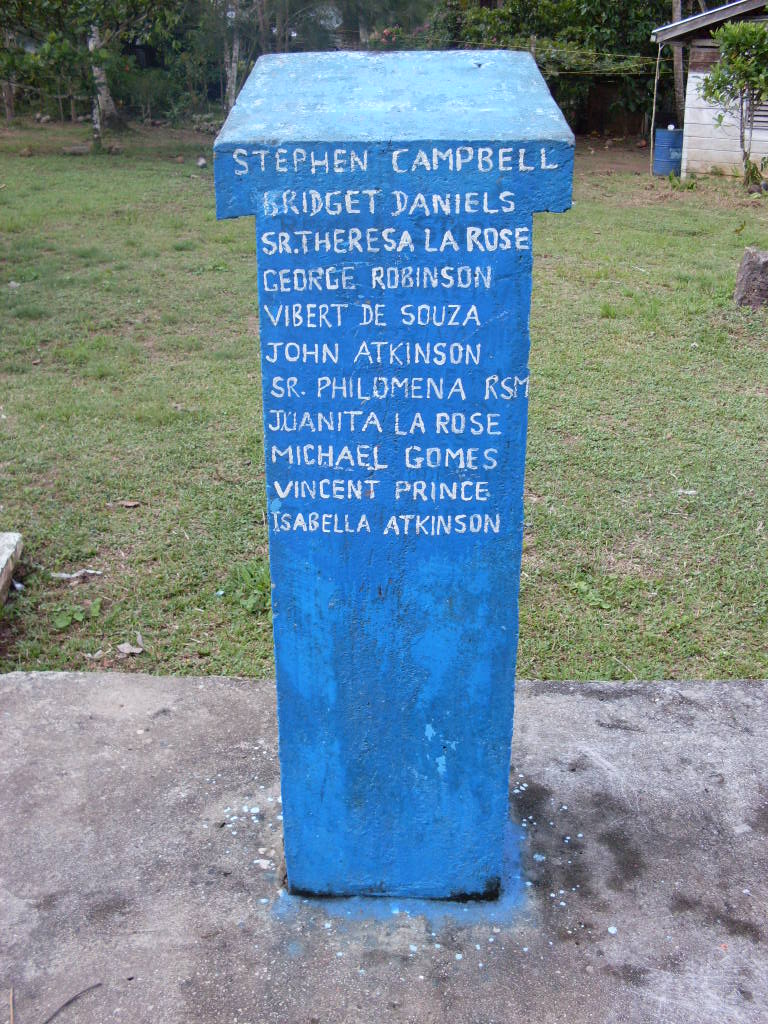
The Amerindian Heroes Monument is located in Santa Rosa Mission, Moruca, Essequibo. Inscribed on the monument are the names of several Amerindian residents who have made invaluable contributions to the community. They include Stephen Campbell, the first Amerindian parliamentarian, John Ferreira, Rosa Atkinson, Anne Prince, Vincent Ferreira, Nash Rodrigues and Basil James who was another member of Parliament. The monument is the brainchild of Basil Rodrigues, a retired schoolteacher. It was completed by self-help in 1995.
The history of the Catholic Church in Moruca.
The history of the Catholic mission to the Amerindian of Guyana actually begins in Venezuela . Throughout the 18th century Spanish Franciscans ministered to the indigenous people of territories around theOrinoco . Their mission however came to an abrupt and tragic end when on 3 May 1817 Simon Bolivar’s forces put to death 26 priests and two lay brothers. The Amerindians fled from the destroyed mission, some seeking refuge in the British held territory around the Moruca River . Years later, when these Arawaks heard that a Catholic priest had arrived in Georgetown they sent word to him asking for someone to come to minister to them. On 24 June 1830, John Hynes, OP arrived in Moruca to spend three days during which he baptized 75 children and married two couples.
From this beginning a mission was developed to other Amerindian communities in the North West . A principal mission was established at Moruca which was dedicated to St Rose of Lima . This mission was quickly to become known by its Spanish name, Santa Rosa . Later a second mission centre was opened up at Morawhanna, closer to the Venezuelan boarder thus expanding the range of communites served by the priests of the North West District.
taken from the history of the Catholic Church in Guyana.
Moruca’s creeping boom
cellphones, minibuses becoming commonplace
An increase in economic activities at Moruca in the North West is anticipated to spur development, providing the villages within the area are afforded support from the administration.
This is according to residents of the sub-region, one of three within Region One. It is nestled along the coastland and positioned as a central connection point for river traffic linking the coast to areas within the region, including the main administrative office at Mabaruma.
While the communities of Moruca are riverain, an accessible road network, connects villages such as Kwebanna, Waramuri, Kamwatta and Manawarin with Santa Rosa, the administrative centre for the area. Several satellite villages are located a few miles away, among them Kamwatta and Chinese Landing.
The roads are considered ‘quality roads’ by the bus operators who ply their trade between the villages, transporting mainly schoolchildren and villagers travelling to work. A bus operator told Stabroek News during a recent visit that he decided to invest in a minibus when he noticed that children and villagers from satellite villages outside Santa Rosa would walk several miles to get to school and their workplace.
He said that the roads do pose some problems for the vehicles during the rainy season but his contribution towards the development of the region is what counts. A trip between the central Kumaka waterfront area to Waramuri, which was this year delegated heritage village as part of Amerindian Heritage Month celebrations, lasts approximately 20 minutes with a few winding turns and hilltops to traverse along the way. The $500 fare is understandable, passengers said during a trip last week, taking into consideration vehicle repairs as well as the price of gas in the area. Gasoline at Kumaka is retailed at approximately $1,000 per gallon.
The fewer than 10 minibuses in the area travel most of the day between the villages and it would appear as if there is virtually no shortage of passengers as the buses travel with half their full complement while journeying between the villages. There are taxis available too, with one elderly resident noting that persons will soon forget how to walk the long distances connecting the villages.
Regional Chairman Fermin Singh told Stabroek News recently that the road network is one of several avenues being developed in the area to link the communities. As a basis for development, he said that schoolchildren especially are what are kept in mind where linking the communities via road is concerned.
He said there are “natural plans” to improve infrastructural development in the area, adding that an improved water and electricity supply are on the cards.
Boats travel to and from the Kumaka waterfront and Charity on the Essequibo Coast daily, transporting cargo and passengers. The fare per passenger is about $3,000 and the hour-and-a-half long trip could be adventurous for first-time travellers to the area. The journey from Charity starts with a 20-minute ride out of the Pomeroon River with a few high-cresting waves along the way.
The river meanders out into the open Atlantic Ocean and some 20 minutes later, the boats head towards the Moruca River which is covered by cascading mangroves.
There are sharp turns which pass through swampy, savannah lands with the village of Waramuri, which lies along the right bank of the Moruca River, being one of the first communities along the way. Santa Rosa lies some 15 minutes away and the Kumaka/San Jose Bridge which was constructed recently, can be seen in the distance as the boats arrive at the Kumaka waterfront.
Residents refer to the communities of Kumka, St Peter, Kabakali and San Jose as ‘islands,’ because they are all surrounded by savannahs with accumulated water.
Kumaka waterfront shopkeeper Yvonne Williams expressed the view that the area has some way to go in terms of development, and that businesses there would have to get the necessary support from the government to progress. She said she has seen the business community in the area evolve over the years and she noted that the minibuses and cars are a recent feature, with the first vehicles coming some time after 2004.
Mobile phones are also a noticeable feature at Moruca; persons there noting that almost every household has a mobile phone. Digicel launched its telecommunications service at Moruca two years ago and the investment by the company is viewed as significant by residents.
The Santa Rosa secondary, primary and nursery schools all lie within walking distance of each other and the hospital, police station and post office as well as the office of the Guyana Elections Commission (Gecom) are also situated close to each other.
Persons expressed a few concerns about the health facilities in the sub-region, some noting that drugs are not always available at the health centres. The area recently saw cases of dengue fever, it was reported, with the dormitory facility which houses children close to the secondary school recording multiple cases of students who contracted the disease recently.
The issue of birth certificates was also raised by residents there, and according to a local shopkeeper, she travelled to the city on more than three occasions to have her applications for her children processed but to no avail. She said the problem lies with the applications reaching the offices of the general registrar in the city.
A Chinese Landing village councillor, who asked not to be named, also stated that the issue was affecting persons in his village and he said there are less than 10 persons in the village who possess birth certificates. He also pointed to an existing problem of a coastlander mining illegally on village lands at Chinese Landing and noted that the Guyana Geology and Mines Commission (GGMC) is aware of the issue but the concerns of the council appear to be falling on deaf ears.
The main economic activities in the Moruca sub-region are fishing, mining and farming. Farming is done on a large scale and farmers transport their produce to Charity for resale. Some 12,000 people live at Moruca, the highest concentration of the population being in the Santa Rosa/Kumaka area.
The communities are occupied by mainly Amerindians from the Arawak and Warau tribes.
http://www.stabroeknews.com/2010/news/stories/09/20/moruca%E2%80%99s-creeping-boom/
An increase in economic activities at Moruca in the North West is anticipated to spur development, providing the villages within the area are afforded support from the administration.
The entrance to the Kumaka Water Front at Moruca; the bridge at right connects Kumaka to the village of San Jose on the other side.
While the communities of Moruca are riverain, an accessible road network, connects villages such as Kwebanna, Waramuri, Kamwatta and Manawarin with Santa Rosa, the administrative centre for the area. Several satellite villages are located a few miles away, among them Kamwatta and Chinese Landing.
The roads are considered ‘quality roads’ by the bus operators who ply their trade between the villages, transporting mainly schoolchildren and villagers travelling to work. A bus operator told Stabroek News during a recent visit that he decided to invest in a minibus when he noticed that children and villagers from satellite villages outside Santa Rosa would walk several miles to get to school and their workplace.
He said that the roads do pose some problems for the vehicles during the rainy season but his contribution towards the development of the region is what counts. A trip between the central Kumaka waterfront area to Waramuri, which was this year delegated heritage village as part of Amerindian Heritage Month celebrations, lasts approximately 20 minutes with a few winding turns and hilltops to traverse along the way. The $500 fare is understandable, passengers said during a trip last week, taking into consideration vehicle repairs as well as the price of gas in the area. Gasoline at Kumaka is retailed at approximately $1,000 per gallon.
A schoolboy rides pass the mini-bus park at Kumaka at Moruca as two mini-buses prepare to leave the area for nearby villages.
Regional Chairman Fermin Singh told Stabroek News recently that the road network is one of several avenues being developed in the area to link the communities. As a basis for development, he said that schoolchildren especially are what are kept in mind where linking the communities via road is concerned.
He said there are “natural plans” to improve infrastructural development in the area, adding that an improved water and electricity supply are on the cards.
Boats travel to and from the Kumaka waterfront and Charity on the Essequibo Coast daily, transporting cargo and passengers. The fare per passenger is about $3,000 and the hour-and-a-half long trip could be adventurous for first-time travellers to the area. The journey from Charity starts with a 20-minute ride out of the Pomeroon River with a few high-cresting waves along the way.
These two monuments were erected at Santa Rosa, Moruca in memory of persons who have represented Moruca in national and international affairs.
There are sharp turns which pass through swampy, savannah lands with the village of Waramuri, which lies along the right bank of the Moruca River, being one of the first communities along the way. Santa Rosa lies some 15 minutes away and the Kumaka/San Jose Bridge which was constructed recently, can be seen in the distance as the boats arrive at the Kumaka waterfront.
Residents refer to the communities of Kumka, St Peter, Kabakali and San Jose as ‘islands,’ because they are all surrounded by savannahs with accumulated water.
Kumaka waterfront shopkeeper Yvonne Williams expressed the view that the area has some way to go in terms of development, and that businesses there would have to get the necessary support from the government to progress. She said she has seen the business community in the area evolve over the years and she noted that the minibuses and cars are a recent feature, with the first vehicles coming some time after 2004.
Mobile phones are also a noticeable feature at Moruca; persons there noting that almost every household has a mobile phone. Digicel launched its telecommunications service at Moruca two years ago and the investment by the company is viewed as significant by residents.
The Santa Rosa secondary, primary and nursery schools all lie within walking distance of each other and the hospital, police station and post office as well as the office of the Guyana Elections Commission (Gecom) are also situated close to each other.
Persons expressed a few concerns about the health facilities in the sub-region, some noting that drugs are not always available at the health centres. The area recently saw cases of dengue fever, it was reported, with the dormitory facility which houses children close to the secondary school recording multiple cases of students who contracted the disease recently.
The issue of birth certificates was also raised by residents there, and according to a local shopkeeper, she travelled to the city on more than three occasions to have her applications for her children processed but to no avail. She said the problem lies with the applications reaching the offices of the general registrar in the city.
A Chinese Landing village councillor, who asked not to be named, also stated that the issue was affecting persons in his village and he said there are less than 10 persons in the village who possess birth certificates. He also pointed to an existing problem of a coastlander mining illegally on village lands at Chinese Landing and noted that the Guyana Geology and Mines Commission (GGMC) is aware of the issue but the concerns of the council appear to be falling on deaf ears.
The main economic activities in the Moruca sub-region are fishing, mining and farming. Farming is done on a large scale and farmers transport their produce to Charity for resale. Some 12,000 people live at Moruca, the highest concentration of the population being in the Santa Rosa/Kumaka area.
The communities are occupied by mainly Amerindians from the Arawak and Warau tribes.
http://www.stabroeknews.com/2010/news/stories/09/20/moruca%E2%80%99s-creeping-boom/
Subscribe to:
Posts (Atom)